

Alibaba.com is the world’s largest B2B marketplace, and its scale and open seller network also make it a target for counterfeiters looking to exploit legitimate demand. If you’ve found a seller misusing your brand, trademark, or copyrighted images, you have clear legal recourse through Alibaba’s Intellectual Property Protection (IPP) Platform.
This guide walks you through the full process: gathering documentation, registering on the platform, filing complaints, and understanding how Alibaba’s penalty system works against repeat infringers. It also covers the important platform changes you need to know about before filing.
Important
Since 2024, Alibaba operates two separate IPP portals. The Alibaba International IPP Platform, ipp.aidcgroup.net, covers AliExpress, Alibaba.com, Lazada, and Miravia. The Taobao & Tmall Group (TTG) IPP covers Taobao, Tmall, and 1688.com. This guide covers the International IPP. If you’re reporting on Taobao or Tmall, you’ll need a separate account on the TTG portal.
If you used the Alibaba IPP Platform before 2024: the most important change is that it has now split into two separate portals. Complaints against Alibaba.com, AliExpress, Lazada, and Miravia go through ipp.aidcgroup.net; complaints against Taobao, Tmall, and 1688.com require a separate account at the TTG portal.
TL;DR
Key takeaways:
- Penalty points reset after 12 months, which means previously penalized sellers can relist. Monitoring for recurrences is as important as filing the initial complaint.
- Use the Alibaba International IPP Platform, ipp.aidcgroup.net, to report counterfeits on Alibaba.com, AliExpress, Lazada, and Miravia. For Taobao or Tmall, you need a separate account on the TTG IPP portal.
- Registration is free and one-time. Once your IP is on file, filing new complaints only takes minutes.
- Sellers have 3 days to respond to complaints. No response means automatic removal.
- Selling counterfeit goods, meaning identical trademark replicas, counts as a “serious violation” under Alibaba’s Three-Strikes rule. Three strikes within 12 months can lead to account termination.
- Copyright, general trademark misuse, and most patent violations use a separate penalty points system. 48 points can lead to termination, with 6 points per violation after the first warning.
- Alibaba’s own AI removes far more infringing listings than manual complaints. Registering your IP on the platform also feeds this proactive detection system.
Remove a counterfeit on Alibaba in 4 steps
The process breaks down into four stages. Steps 1–3 are one-time setup. Once you’re registered and your IP is on file, you only need to repeat Step 4 for each new infringement.
Step 1: Gather your documentation
Filing a complaint without the right paperwork is the most common reason for delays or rejections. Before you open the platform, make sure you have:
| Document type | What to prepare |
| Identity, individual | National ID card or passport |
| Identity, company | Certificate of incorporation |
| IP ownership | Trademark certificate, copyright registration, patent certificate, or equivalent documentation showing you are the rights holder |
| Evidence of infringement | URLs of infringing listings, screenshots, side-by-side comparison images, product photos, or packaging evidence |
| Authorization, if applicable | Power of attorney or letter of authorization, if you’re filing on behalf of the rights holder |
One important note: if you’re using a trademark agent or brand protection service, they will also need to upload documentation supporting their authorization to act on your behalf.
Tip: Does your IP need to be registered in China?
No. The Alibaba International IPP Platform accepts foreign IP registrations. However, having your trademark or patent registered in China significantly smooths the enforcement process and reduces the risk of complaints being disputed or delayed. Many international brands register in China specifically to strengthen their position on Alibaba’s platforms.
Step 2: Register on the Alibaba International IPP Platform
Go to ipp.aidcgroup.net and create a free account. You’ll need to provide basic information about yourself or your company and verify your contact details before you can file complaints.
Note: Account verification typically takes up to three business days for new registrations. Your account is only considered ready for use once at least one IP owner and one IP record have been verified.
Step 3: Register your Intellectual Property Rights
Once inside your account, go to My IPR > IPR Submission to register your IP. This step is required before you can file any complaints. Alibaba uses your registered IP records to validate takedown requests.
Requirements vary by IP type:
| IP Type | Required Information |
| Trademark | Name, registration number, registrant, expiration date, class of goods, related brand name. Upload renewal, assignment, or modification certificates if applicable. |
| Copyright | Name of work, registration number, or Copyright Claim Statement for unregistered works, downloadable from the platform, rights holder details, evidence of creation. |
| Patent | Patent type, invention/design/utility, registration number, rights holder, validity dates, patent certificate. |
| Other IP | Name and number, rights holder, validity period, supporting documents. |
Track the status of your submissions under IPR Management > My IPR. If a submission is rejected, the platform will explain why. You can supplement and resubmit.
Step 4: File a complaint
Once your IP is verified, click Submit a Complaint in the left-hand navigation. You’ll be guided through the following:
- Select the platform to enforce on: Alibaba.com, AliExpress, Lazada, or Miravia.
- Choose the type of infringement: trademark, copyright, or patent.
- Select the enforcement target: product listing or storefront. Storefronts require submission by email.
- Specify your reason and upload supporting evidence.
- Paste the infringing URLs, up to 300 per submission.
- Submit.
Duplicate URLs and URLs already under an active complaint will be rejected, so review your list before submitting. Use the Manage Complaints section of your dashboard to track progress on every filed complaint.
What happens after you report
Once a complaint is submitted, the seller has three days to respond. If they don’t, Alibaba automatically removes the listing and upholds the complaint.
If the seller challenges the complaint:
- The first appeal adds 3 days.
- Each of two further appeals adds 7 days.
- Sellers can appeal a maximum of 3 times.
Watch your inbox
Register with an email address your team monitors regularly. If a seller submits a counter-notification, you must accept or reject it within the response window. Failing to do so results in the listing being reinstated automatically.
Alibaba’s counterfeit policy and penalty system
Alibaba prohibits any listings featuring counterfeits or unauthorized items. Beyond reactive enforcement, the platform conducts proactive checks of seller profiles and product details, removing or rejecting listings it suspects of IP violations.
Sellers who receive confirmed infringement complaints accumulate penalty points. The severity depends on the type of infringement.
The Three-Strikes Rule, serious violations
Only selling products that directly replicate registered trademarks, counterfeit goods in the strictest sense, qualifies as a “serious violation” and counts as a strike. Three confirmed strikes within a 12-month rolling window result in permanent account termination.
Between strikes, Alibaba requires the seller to complete mandatory IP education and pass an examination before their account is restored. Sellers who pass can resume selling, which is why the Three-Strikes system requires sustained enforcement effort by rights holders.
Whack-a-mole risk
Sellers often remove infringing listings after a complaint, wait for the strike window to reset, then relist under a new URL. Each new listing requires a fresh complaint and, for a serious violation strike, a new test purchase as evidence. Strikes recorded as serious infringements remain on record for 365 days.
General violations and penalty points
All other infringement types, including copyright, unfair trademark use, and most patent violations, are categorized as “general violations” and handled through a penalty points system rather than the three-strikes framework.
| IP Type | Violation Category | First Offense | Path to Termination |
| Trademark, counterfeit | Serious violation | Strike 1 of 3 | 3 strikes = terminated |
| Trademark, other misuse | General violation | Warning, no points | 48 penalty points = terminated; 6 points per subsequent violation |
| Copyright | General violation | Warning, no points | 48 penalty points = terminated; 6 points per subsequent violation |
| Patent, serious | Serious violation | Strike 1 of 3 | 3 strikes = terminated |
| Patent, general | General violation | Warning, no points | 48 penalty points = terminated; 6 points per subsequent violation |
Note: The penalty points reset mechanism means sellers may become active again after one year if they haven’t been terminated. For brands facing repeat infringers, monitoring for relisted products is as important as filing the initial complaint.
Alibaba’s proactive enforcement ecosystem
Manual complaints are only part of the picture. Alibaba has built a broader proactive enforcement infrastructure that rights holders should be aware of and, where possible, participate in.
- AI-powered proactive detection: Alibaba’s algorithms scan billions of product images daily, using image recognition, semantic analysis, and optical character recognition to flag suspected infringing listings before rights holders even see them. Over 97% of suspected infringing goods are removed from Alibaba platforms as soon as they are posted online.
- Hidden links enforcement: A growing tactic among counterfeiters is the use of “hidden links”, listings for seemingly unrelated products that actually offer counterfeit goods, promoted via social media and private chat groups. Alibaba has specifically expanded its algorithms to detect and remove these deceptive listings.
- Alibaba Anti-Counterfeiting Alliance (AACA): The AACA is a collaboration between Alibaba and over 221 rights holders from 21 countries, representing nearly 1,200 brands including Apple, Chanel, and 3M. Members gain access to the Queqiao monitoring program, which enables one-click takedowns, dashboard tracking of suspected infringements, and cooperative intelligence sharing. Brands that qualify should explore AACA membership as a complement to manual IPP complaints.
- Offline investigations: Alibaba actively supports law enforcement referrals and has initiated civil litigation against sellers of counterfeit goods on its own platforms. In 2022 alone, Alibaba’s offline enforcement efforts led to over 2,100 investigations and 2,700 criminal arrests.
How Red Points automates Alibaba enforcement at scale
Filing a handful of complaints manually is manageable. But Alibaba.com hosts millions of supplier listings, and counterfeiters are sophisticated. They relist quickly, use hidden links, and operate across multiple storefronts simultaneously. Red Points’ Marketplace Protection platform is built for this volume.
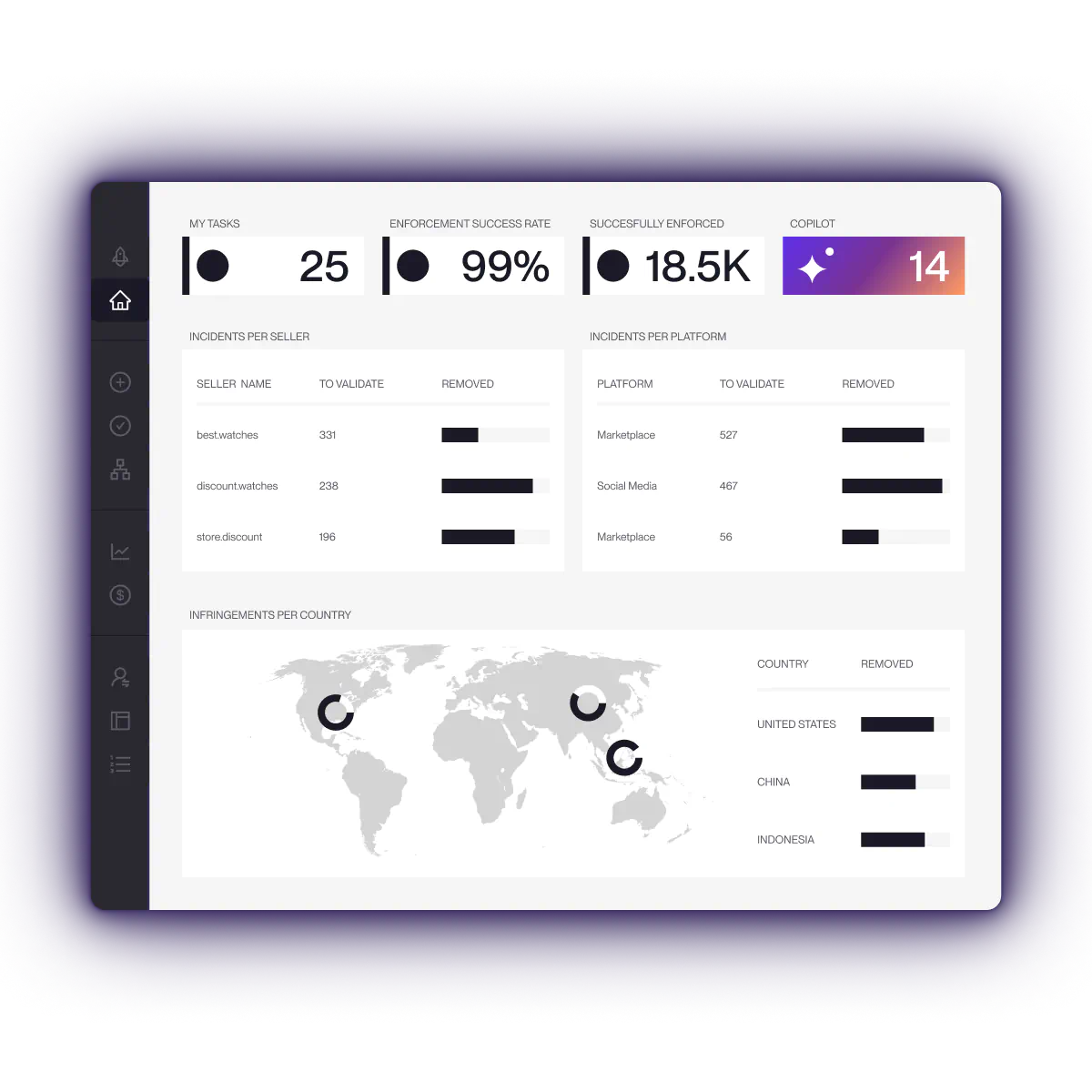
Red Points monitors 1.4 billion domains and scans more than 5,000 marketplaces, including Alibaba.com, AliExpress, and Alibaba’s domestic platforms, using image recognition, text matching, and behavioral signals to detect infringing listings and storefronts as they appear. When infringement is detected, the platform automatically collects evidence and submits takedown requests through the Alibaba IPP Platform without requiring manual login for each case.
For the repeat-offender problem, sellers who relist after a complaint, wait for the annual penalty point reset, then relaunch under a new URL, Red Points tracks returning sellers and files new complaints automatically, maintaining the enforcement pressure that the Three-Strikes system requires to reach termination.
Red Points delivers a 94–95% enforcement success rate across 5.1 million enforcements per year for 1,300+ brands spanning Alibaba, Amazon, eBay, social media, and the open web.
Request a demo to see how Red Points handles Alibaba enforcement for your product category.
Frequently asked questions
What is the Alibaba IP Protection Platform and is it free to use?
The Alibaba International IPP Platform, ipp.aidcgroup.net, is Alibaba’s official portal for rights holders to register their IP and file infringement complaints across Alibaba.com, AliExpress, Lazada, and Miravia. Registration and complaint submission are both free.
Do I need a Chinese trademark to file a complaint on Alibaba?
No. The Alibaba International IPP Platform accepts foreign trademark, copyright, and patent registrations. That said, having your IP registered in China significantly strengthens your complaints and reduces the risk of disputes or delays. Many international brands register in China specifically to improve their enforcement position on Alibaba’s platforms.
How long does it take Alibaba to remove a counterfeit listing?
In most cases, listings are removed within 24 hours of a valid complaint being submitted, especially if the seller doesn’t respond within the 3-day window. Alibaba states that 95% of IP complaints, excluding bad faith submissions, are resolved within one business day.
What’s the difference between Alibaba.com and AliExpress for IP enforcement?
Alibaba.com is a B2B platform connecting manufacturers and wholesale suppliers with business buyers, while AliExpress is a B2C consumer marketplace. For IP enforcement purposes, both fall under the same Alibaba International IPP Platform, and complaints can be filed against either from the same account. The type of infringing activity may differ: Alibaba.com counterfeits are typically found at the supply/sourcing level, while AliExpress counterfeits target end consumers.
What is Alibaba’s Three-Strikes rule and how does it work?
The Three-Strikes rule applies specifically to serious violations, defined as selling products that directly replicate a registered trademark, i.e. genuine counterfeit goods. A seller who receives three confirmed strikes within a 12-month rolling window is permanently banned from the platform. Between strikes, Alibaba requires sellers to complete mandatory IP education. Strikes are recorded for 365 days.
What happens if a seller appeals my takedown complaint?
If a seller challenges your complaint, the first appeal extends the resolution window by 3 days. Each of up to two further appeals adds 7 days. If the seller’s appeal is upheld, the listing may be reinstated. You must respond to any counter-notifications within the reply window. Failing to do so will result in automatic reinstatement of the listing.
Can I report a seller’s entire storefront, not just individual listings?
Yes. When filing a complaint, you can choose between enforcing against a specific product listing or an entire storefront. Note that storefront enforcement requires submission by email rather than through the standard online complaint form.
Why does a seller I got removed keep coming back?
This is a common problem. Sellers often remove infringing listings after a complaint, wait for the annual penalty point reset, then relist under a new URL. Each new listing requires a fresh complaint, and for serious violation strikes, a new test purchase as evidence. Automated brand protection tools are better equipped to detect and respond to these recurring sellers than manual monitoring.
What is the AACA and should my brand join?
The Alibaba Anti-Counterfeiting Alliance (AACA) is a collaboration between Alibaba and over 221 rights holders from 21 countries, representing nearly 1,200 brands. Members gain access to the Queqiao monitoring program, which includes one-click takedowns, proactive infringement alerts, and cooperative intelligence with other brands and law enforcement. If your brand experiences frequent counterfeiting on Alibaba’s platforms, AACA membership is worth exploring as a complement to standard IPP complaint filings.
What’s the difference between the Alibaba International IPP and the TTG IPP?
Since 2024, Alibaba operates two separate IPP portals. The Alibaba International IPP, ipp.aidcgroup.net, covers Alibaba.com, AliExpress, Lazada, and Miravia. The Taobao & Tmall Group (TTG) IPP covers Taobao, Tmall, and 1688.com. These are separate registrations with separate accounts. You cannot file across both ecosystems from a single login.