



If fake Telegram accounts are impersonating your brand, running crypto schemes, or tricking your customers into handing over personal information, you can report them — and you should act quickly. Telegram provides an official reporting bot and an in-app reporting option, but the process for high-volume or repeated abuse requires more than one-by-one manual reporting.
This guide walks through how to report a scam on Telegram step by step. It also covers the most common types of Telegram scams targeting brands, tips for keeping your customers safe, and why manual reporting often stops being enough once infringement starts to scale.
TL;DR
- Telegram offers an official reporting bot — @notoscam — as well as an in-app reporting option for flagging scam accounts and channels directly.
- You will need a Telegram account to report through the bot. For email-based reports, you can contact abuse@telegram.org with as much detail as possible.
- Telegram infringements targeting brands have increased significantly — impersonation, crypto fraud, and counterfeit sales channels are the most common types brands face.
- Common Telegram scams include fake brand groups, crypto investment fraud, phishing bots, job scams, and counterfeit sales channels.
- Manual reporting works for isolated cases, but brands dealing with repeated or large-scale abuse need continuous monitoring and automated enforcement to keep up.
Telegram scam reporting at a glance
| Step | What you do | Why it matters |
| Step 1 | Open the Telegram app and log in | You need an active account to report through the bot or in-app |
| Step 2 | Search for @notoscam | Connects you to Telegram’s official anti-scam reporting channel |
| Step 3 | Tag the scammer account or channel and explain the abuse | Gives Telegram’s team the context needed to review the report |
| Step 4 | Send the message for Telegram review | Submits the report for action if community rules are violated |
| Alternative | Report directly in-app via the user profile (three dots → Report) | Faster option for reporting individual accounts or channels |
| Alternative | Email abuse@telegram.org with full details | Useful for complex cases or where the bot channel is insufficient |
Video walkthrough
Before you start: what to have ready
Before opening the bot or sending an email, gather the information Telegram is likely to need. This typically includes the username or link of the scam account or channel, a clear description of the abusive behaviour, any screenshots that show impersonation, phishing content, or fraudulent claims, and — for brand-related cases — evidence that the account is using your name, logo, or likeness without permission. Submitting a complete report from the start reduces delays and improves the chances of action being taken.
Telegram has an official bot channel called No To Scam which you can use to report any kind of scam discovered on the platform. Below is how to use it.
Step 1: Open Telegram
To report a user on Telegram, first open the Telegram app. Note that you need to have a Telegram account to report any account or channel. The website does have a form on its support page to report a Telegram account, but it is for general issues. Reporting a channel or user there for fraud may lead to your message getting lost.
Step 2: Look up @notoscam
Once you are logged into your account, go to the chat section and search for the @notoscam bot. The name of the bot is Report Impersonation and it has a verified tick on it. You can also use this direct link to access the channel.
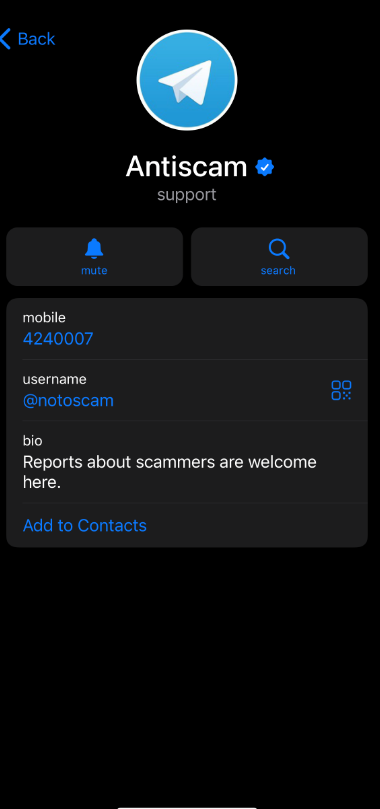
Step 3: Tag the scammer and explain the abuse
Start typing in the chat window by tagging the scammer account or channel and then explaining the reason behind the report. Include as much detail as possible — the more context you give, the easier it is for Telegram’s team to act.
Step 4: Send the report for Telegram review
Send the message. The Telegram team will review your report and, if the user is found to be violating community rules, they will take the necessary action.You can also directly report a Telegram scam account or channel through the in-app option: go to the user’s profile, tap the three dots in the top right corner, select Report, choose the reason, and submit. For more complex cases, you can also send an email to abuse@telegram.org explaining the situation with as much information as possible.
Top 5 Telegram scams brands face most
Telegram scams are fraud schemes that either take place on the app itself or use it to move users toward suspicious third-party websites — often impersonating a legitimate business. Scams on Telegram range from traditional phishing attacks to sophisticated fraud where bad actors pose as customer support agents or investment advisors.
Red Points has validated over 200,000 infringements on Telegram. Here are the types we see most often.
1. Fake Telegram groups and channels
Telegram’s ability to support large groups and channels is one of its main draws — and one of the main reasons scammers exploit it. Bad actors create copycat channels that mirror the original: same admin usernames, same pinned messages, same media. The goal is to create a false sense of trust and then get users to click suspicious links or hand over personal information.
Research from Sapienza University of Rome and Temple University found that political figures, public figures, and business services are the main targets of fake groups on Telegram. For brands, the risk is that customers believe they are engaging with an official channel when they are not.
2. Telegram crypto scams
Telegram has become a popular platform for cryptocurrency communities — and a popular hunting ground for crypto scammers. Fraudsters pose as crypto experts, promise guaranteed returns, and build trust over time before pushing fake investment schemes. They also run giveaways and sweepstakes that require users to provide personal or banking details — or pay a small upfront fee — before any prize can be claimed.
In a commonly reported pattern, a user joins a crypto Telegram group with thousands of apparent members — most likely bots — and is told they cannot withdraw their investment without adding a further deposit, typically 10–15%. The funds remain inaccessible regardless of additional deposits.
3. Telegram phishing scams
Telegram’s bot feature — which allows businesses to automate conversations using AI and natural language processing — is also used by scammers to impersonate banks, tech companies, and customer support teams. The bots can be convincing enough that users provide login credentials, banking details, or personal data believing they are speaking to a real representative.
According to SafeGuard Cyber’s 2023 Business Communications Risk Report, about 24% of flagged messages across monitored platforms occurred in Telegram, and 42% of all flagged messages were specifically flagged for impersonation.
4. Telegram job scams
Job scams on Telegram target people actively looking for work. A scammer contacts a job seeker posing as a recruiter from a well-known company, then asks them to create a Telegram account and complete their “interview” through the app. Once signed up, the applicant shares personal information under the impression they are applying for a real role. These scams typically offer implausibly high rates for common positions like administrative assistants or customer service representatives to make the opportunity seem attractive.
5. Counterfeit sales channels
Scammers also use Telegram channels to sell counterfeit products — sometimes openly, and sometimes by impersonating the genuine brand and claiming the goods are authentic. Either way, the consequences for brands can be serious: customers receive poor-quality fakes, associate the experience with the real brand, and damage is done to brand reputation that can be difficult to reverse.
Tips for keeping your customers safe from Telegram scams
Red Points has seen Telegram infringements increase by 182% since 2022, with a 116% rise in the most recent quarter alone. When scam accounts multiply this fast, reactive takedowns are not enough on their own. Brands also need to make it harder for customers to be deceived in the first place.
Educate customers on your official brand channels
Your customers may not know which channels are genuinely yours. Scammers often add emojis to a brand name or use the word “official” to trick users into thinking a channel is legitimate. Clearly promote your actual channels across every platform you use, and periodically remind customers where they can and cannot contact you. If you do not have a Telegram presence at all, make that explicit in your contact information.
Share tips on identifying fake accounts
Help customers spot the difference between your account and a fake one. Show them what to look for: differences in username format, typography, profile photos, pinned messages, and posting style. Visual examples — side-by-side comparisons, annotated screenshots — are particularly effective for making these distinctions clear.
Post regular security updates
Periodically remind your audience that scams exist and are actively targeting your brand. Share examples when you uncover infringing accounts. Keep customers informed about what your company is doing to identify and remove them. Transparency builds trust and gives customers the context they need to protect themselves.
When manual Telegram reporting is not enough
Knowing how to use the @notoscam bot is a useful starting point. But for many brands, the real challenge is not knowing where to report — it is keeping up with the volume.
Manual reporting breaks down when the same fake templates are reused across multiple channels, when new accounts appear as fast as old ones are removed, or when Telegram abuse is part of a broader cross-channel problem involving fake websites, social media impersonation, and counterfeit listings. At that point, the question is no longer “How do I report this account?” It becomes “How do we stay ahead of this at scale without burning out our team on repetitive enforcement?”
How Red Points scales Telegram enforcement
When Telegram scams become frequent, repeated, or tied to a wider pattern of brand abuse, brands need more than a manual reporting workflow. They need a system that continuously finds new infringements, validates them quickly, and moves into enforcement without creating bottlenecks.
Red Points combines always-on detection, AI-assisted validation, and platform-specific enforcement so brands can take back control of how they appear on Telegram — and across every other channel where scammers operate. Our Social Media Protection Software detects impersonation in real time, validates large volumes of infringements at speed, and removes harmful content not just on Telegram but across the wider digital ecosystem — websites, ads, marketplaces, domains, and search engines.
Red Points has validated and removed over 200,000 infringements on Telegram. Whether scam accounts are impersonating your customer service team, running fake crypto channels in your brand name, or selling counterfeits in Telegram shops, our platform handles the detection, enforcement, and reporting so your team does not have to.
Connect with one of our experts to take back control of your brand’s reputation on Telegram.
Frequently asked questions about Telegram scams
You can report a scammer using Telegram’s official @notoscam bot. Search for the bot in the app, tag the scam account or channel, explain the abuse, and send the message. You can also report directly in-app by going to the user’s profile, tapping the three dots, and selecting Report. For complex cases, email abuse@telegram.org with full details.
Yes. To report through the @notoscam bot or the in-app reporting option, you need an active Telegram account. The email route (abuse@telegram.org) does not require an account.
Include the username or link of the scam account, a clear description of the abusive behaviour, screenshots showing impersonation or fraudulent activity, and — for brand-related cases — evidence that your name, logo, or identity is being misused.
Telegram’s team reviews the report. If the account is found to be violating community rules, they will take action — which may include removing the account or channel. Response times can vary.
Yes. You can send a report to abuse@telegram.org with as much information as possible. This is particularly useful for complex cases that go beyond what the bot can handle.
The most common types include fake groups and channels that impersonate official brand accounts, crypto investment fraud, phishing bots posing as customer support, job scams that harvest personal data, and counterfeit sales channels that use a brand’s name to sell fake products.
Yes. Customers who are defrauded by accounts impersonating your brand often blame the brand for not doing more to stop it. Reputational damage and loss of trust can occur regardless of whether your business had any involvement.
Because scammers often operate across multiple accounts and channels simultaneously, and new fakes appear quickly as old ones are removed. Manual one-by-one reporting cannot keep pace with repeated or large-scale abuse. Continuous monitoring and automated enforcement are more effective for brands with significant Telegram exposure.
When infringement is frequent, involves multiple accounts, or is part of a wider cross-channel problem that includes fake websites, ads, or marketplaces. At that point, a managed brand protection platform that combines detection, validation, and enforcement delivers better results than manual reporting alone.