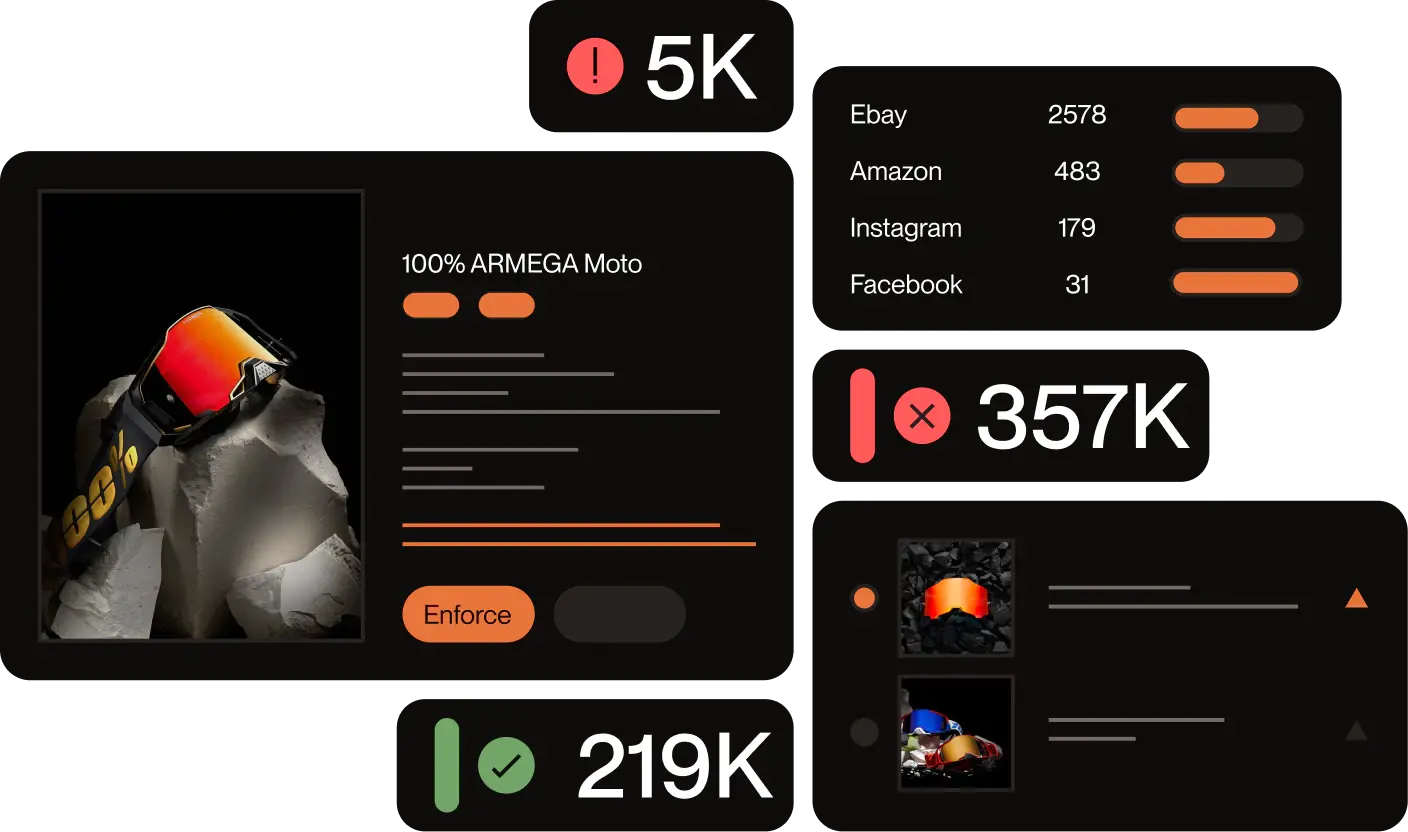



The best online brand protection tools for 2026 are Red Points, Corsearch, MarqVision, BrandShield, Bolster, CSC, and OpSec. Red Points is the strongest fit for brands that need unlimited takedowns, broad marketplace, social, web, domain, and ad coverage, and managed enforcement at scale.
- Red Points combines unlimited takedowns, AI-powered detection, and proven enforcement outcomes to protect brands at any scale without cost volatility.
- Nearly 1 in 3 buyers who accidentally receive a counterfeit stop purchasing from the original brand, which is why the right brand protection matters.
- This guide draws on 2.7 billion monthly data points, 1,300+ brands, and insights from 150+ companies that switched providers.
Quick verdict: Red Points is best for brands that need scalable enforcement across marketplaces, social media, websites, domains, paid ads, apps, gray market abuse, impersonation, piracy, and domestic Chinese platforms, with unlimited takedowns included in a flat-fee model.
Brand protection tools vary significantly: from full trademark lifecycle management to narrowly focused domain security tools. Knowing where each excels and falls short helps you match a solution to your actual risk surface.
Red Points has protected more than 1,300 brands since 2011, processing 2.7 billion data points every month across marketplaces, social media, ads, and domestic Chinese platforms. The platform detected 4.3 million infringements in 2024 alone and holds a G2 rating of 4.8/5 from 50 verified customer reviews. This gives us a unique position to help businesses choose the right brand protection services for the threats they face.
Quick comparison of the best online brand protection tools
Detailed capability comparison
| Platform | Best for | Marketplace protection | Phishing & impersonation | Domain protection | Takedown model |
|---|---|---|---|---|---|
| Red Points | Multi-channel enforcement at scale | Strong | Strong | Strong | Unlimited |
| Corsearch | IP-heavy legal teams | Strong | Partial | Strong | Volume-based / service-led |
| MarqVision | Marketplace and seller monitoring | Strong | Partial | Partial | Volume-based |
| BrandShield | Phishing, impersonation, and cyber-led abuse | Partial | Strong | Strong | Package-based |
| Bolster | Phishing and fake site detection | Limited | Strong | Strong | Case-based |
| CSC | Domain portfolio protection | Limited | Partial | Strong | Service-based |
| OpSec | Product authentication and enterprise enforcement | Strong | Partial | Partial | Service-based |
Comparison summary: Red Points is the strongest fit for brands that need unlimited detections and takedowns, cross-channel enforcement, domestic Chinese marketplace coverage, AI risk prediction, and seller intelligence. Corsearch is strongest for trademark lifecycle management and offline investigations. BrandShield is strongest for cybersecurity-led brand protection and actor clustering. Bolster is strongest for phishing and domain abuse. CSC is strongest for domain security. OpSec is strongest for product authentication and track-and-trace.
The table below isolates the enforcement capabilities that most directly determine real-world outcomes, which are unlimited takedowns, domestic Chinese platform access, AI-driven seller risk prediction, and cross-channel seller clustering intelligence.
Disclaimer:
This comparison is based on publicly available product documentation, vendor websites, and customer feedback shared during evaluations and reviews, as of December 2025. Capabilities, pricing models, and enforcement approaches may change over time.
How we ranked these tools (methodology)
This guide is based on observed performance, not vendor claims.
Our analysis draws on:
- 2.7 billion monthly data points across marketplaces, social media, ads, domains, and websites
- Protection programs supporting 1,300+ brands globally
- Insights from 150+ companies that switched providers from another company to Red Points in the last two years
- Secret shopping analysis of pricing and service offering
- Public customer reviews, documented capabilities, and enforcement outcomes
Each tool was evaluated across:
- Channel coverage
- Enforcement scalability
- Automation maturity
- Takedown limits and pricing structure
- Operational model and support
- Revenue impact and long-term ROI
With nearly 15 years of experience, we have observed shifts in counterfeiting tactics, enforcement protocols, and platform policies. That perspective allows us to differentiate between marketing claims and capabilities that genuinely reduce risk.
The 7 Best Brand Protection Tools for 2026
1. Red Points
Best for: Global brands seeking scalable protection, with expert enforcement and dedicated support.
Red Points is the most widely used AI-led brand protection platform, designed for brands that need consistent, scalable enforcement across marketplaces, social commerce, websites, domains, paid ads, app stores, impersonation threats, gray market networks, piracy channels, and domestic Chinese platforms.
The platform serves SMEs, mid-market companies, and enterprise brands, covering every size from a fast-growing direct-to-consumer brand to a multinational with hundreds of product lines. What separates Red Points from many competitors is its flat-fee pricing model, which includes unlimited detections and unlimited takedowns on every plan.
Red Points’ detection engine processes 2.7 billion data points per month and references a database of more than 50 million previously identified infringers. The AI applies image recognition, optical character recognition (OCR), logo fingerprinting, and machine learning to identify counterfeit product listings, impersonation accounts on social media platforms, and unauthorized distributor listings on e-commerce marketplaces.
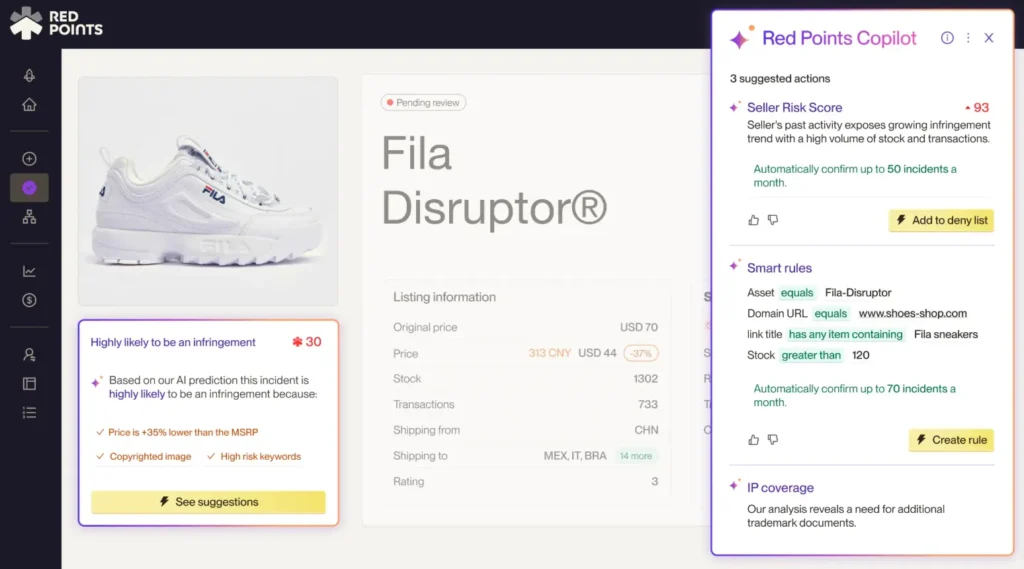
A Seller Risk Score and Infringement Prediction model prioritize threats most likely to cause revenue damage or repeat abuse. ASICS made use of this specifically when it went from enforcing 150 counterfeit listings per month to more than 20,000, achieving a 99.7% enforcement success rate after switching to Red Points. Similarly, Fila removed $570M in counterfeit sportswear. CATAN removed 224,000 counterfeit board games and recorded its best sales year immediately after.
What are Red Points’ pros and cons?
Pros
- Flat-fee model with unlimited detections and takedowns, always-on with no volume caps
- AI trained on 2.7 billion monthly risk data points and a database of 50 million+ infringer records
- Coverage across marketplaces, social media, websites, paid ads, app stores, and domestic Chinese platforms, including Goofish, Pinduoduo, WeChat, and Douyin
- Rated 4.8 on G2 from 50 reviews
- Predictive seller risk scoring and infringement prioritization for highest-impact enforcement
- Dedicated Implementation Specialist and Customer Success Manager included on every plan
- Revenue Recovery Program for self-funded litigation against infringing sellers at scale
Cons
- Offline investigations handled through partner firms, not an in-house investigation team
- Trademark registration available only through industry partners, not natively
- Price point sits higher than some alternatives in the same category
What brand protection tools does Red Points offer?
Red Points covers the main areas of online brand protection: marketplace enforcement, social media impersonation, fake websites, fraudulent ads, domain abuse, app stores, piracy, gray market sellers, unauthorized distributors, and domestic Chinese platform monitoring, with no volume cap on any covered channel.
- Unlimited takedowns: Removes counterfeit product listings, fake social media accounts, fraudulent paid ads, phishing websites, pirated content, and gray market distributor listings with no volume cap
- Dedicated specialists: AI platform fully operated by IP-Ops experts, with a dedicated Customer Success Manager and service excellence team
- Wide coverage: Anti-counterfeiting, anti-impersonation, anti-piracy, and gray market protection, plus domain management and social video rights enforcement
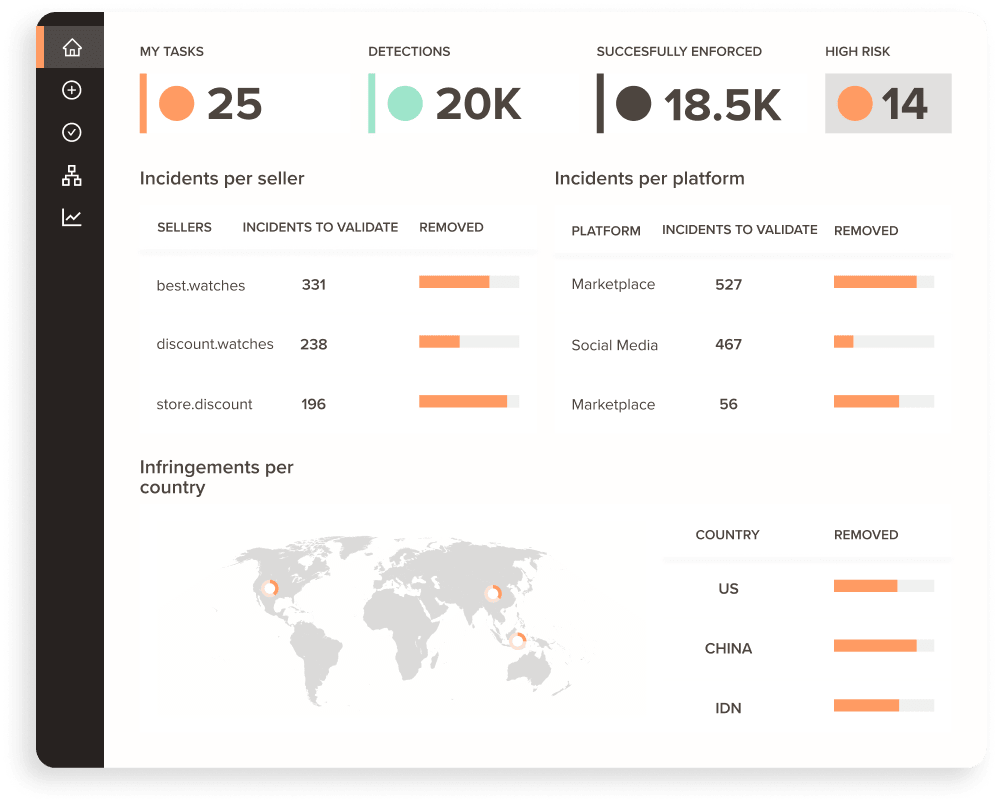
- Intuitive dashboards: Anti-fraud dashboards provide granular data on infringement trends, seller networks, and ROI
- Revenue Recovery Program: Self-funded litigation program that freezes seller funds and permanently disrupts infringing seller networks
- Real-time tracking: Tracks detected and enforced incidents in real time, including status after removal
How much does Red Points cost?
Red Points uses a flat fee model that includes unlimited takedowns by channel. Implementation and Customer Success management are included in all plans at no additional cost.
2. Corsearch
Best for: Traditional brand protection teams looking for a single offline-first IP solution, without speed or scalability needs.
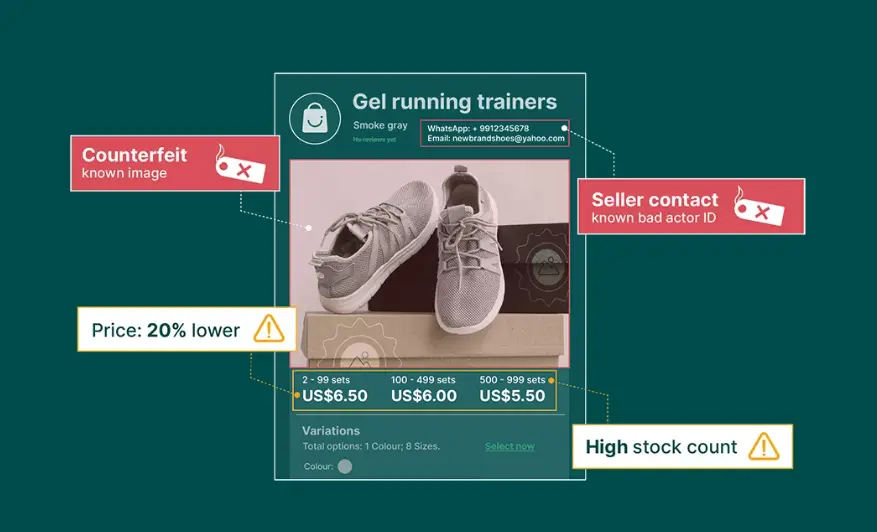
Corsearch is best suited for enterprise brands that need full trademark lifecycle management alongside digital enforcement. Founded in 1949, Corsearch built its business around trademark registration, clearance searches, and analyst-led enforcement programs.
The company now offers Corsearch Zeal 2.0, an AI-powered brand protection platform that consolidates capabilities from four acquired companies: YellowBP, PointerBP, Incropro, and Navee. This consolidation gives Corsearch broad service coverage, including trademark registration, anti-counterfeiting, anti-piracy, domain management, and offline anti-counterfeiting investigations. Enterprise brands with complex trademark portfolios and a need for investigation and raid operations in international markets are Corsearch’s strongest fit.
Where Corsearch falls short is in enforcement scalability. Its model depends heavily on analyst hours and intelligence packages, which means enforcement capacity is constrained by how many review days a client’s plan includes.
The platform does not include machine learning, image recognition, or OCR, which limits automated detection precision. On G2, Corsearch holds a 4.7/5 rating from just 5 reviews, with two of those appearing to reference “Yellow Brand Protection” rather than Corsearch directly. Some public customer reviews raise concerns about enforcement disputes and alleged false-positive takedowns. Corsearch supports English only, a meaningful gap for brands operating in multilingual markets.
What are Corsearch’s pros and cons?
Corsearch’s full trademark lifecycle management and offline raid operations make it the strongest fit for enterprise IP teams managing complex trademark portfolios, but analyst-hour enforcement caps and the absence of machine learning limit scalability during infringement spikes.
Pros
- Full trademark lifecycle management: from registration and clearance to monitoring and enforcement
- Strong enterprise focus with a large-catalog trademark portfolio management
- Covers offline investigations and raid operations in international markets
- Broad service portfolio covering trademark management, anti-counterfeiting, anti-piracy, and domain protection
- The scope can be adjusted geographically as infringement patterns shift across regions
- Recently launched a Revenue Recovery Program
Cons
- Enforcement capacity capped by analyst hours and review days
- Heavy reliance on manual analyst workflows limits scalability during infringement spikes
- No machine learning, image recognition, or OCR in platform comparison data
- English only: no multilingual platform support
- High client burden at onboarding: extensive trademark and product documentation required upfront
- Thin G2 social proof: 5 reviews overall
- Pricing above the industry average because the model depends on manual analyst labor
What brand protection tools does Corsearch offer?
Corsearch’s platform spans trademark clearance searches and registration management to offline investigation and anti-piracy enforcement, making it the broadest trademark services provider in this comparison at the cost of automation depth.
- Trademark solutions: Trademark clearance searches, registration management, and monitoring for conflicting trademark filings
- Brand protection: Counterfeit listing removal, brand impersonation takedowns, and gray market seller enforcement
- Domain protection: Cybersquatting detection and domain registration portfolio management
- Investigations 360: Offline investigation and raid support to pursue counterfeiters at the source
- Anti-piracy: Content protection for books, games, software, and digital media
How much does Corsearch cost?
Corsearch pricing varies by intelligence hours, analyst hours, service package, and contract scope. For more details, read our full Red Points vs Corsearch comparison.
3. MarqVision
Best for: Small teams or companies starting brand protection efforts, focusing on Korean and Japanese markets with a limited scope.
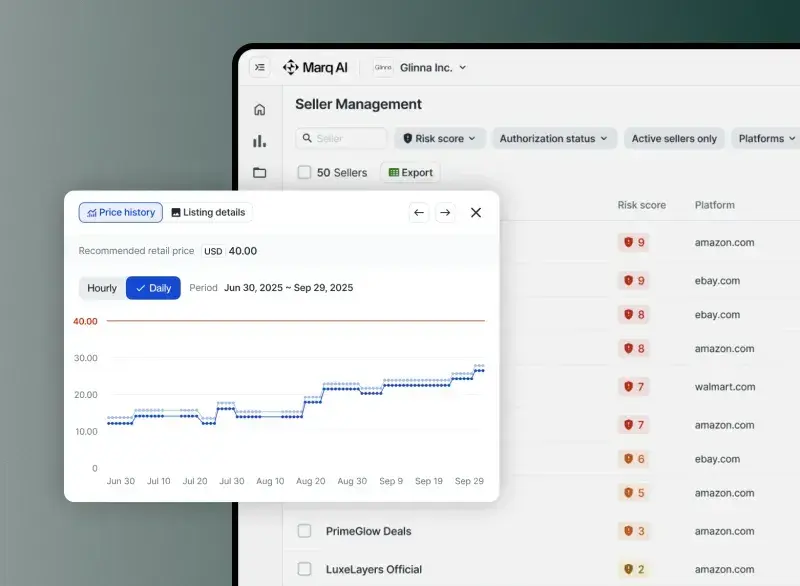
MarqVision is a brand protection platform founded in 2020 that covers more than 1,500 marketplaces and has particularly strong coverage of Asian e-commerce platforms and domestic Chinese marketplaces.
MarqVision focuses on fashion, luxury goods, technology, and consumer product brands from SMB to enterprise. Its AI uses image recognition, image fingerprinting, logo recognition, and OCR to detect counterfeit product listings, impersonation accounts, and unauthorized distributor behavior.
On G2, MarqVision holds a 4.9/5 rating from 29 reviews. Customers frequently praise responsive account management, weekly check-in meetings, and detection quality. One reviewer mentioned that the simple dashboard is easy to use for enforcement actions.
MarqVision’s main weakness is enforcement speed. Multiple G2 reviewers noted that removing reported listings can take longer than expected. The platform was slow to adapt when TikTok Shop launched, with approximately a one-month lag before detection became available. MarqVision also does not cover rogue mobile apps, a gap for brands that face app store impersonation. With 29 G2 reviews versus Red Points’ 50, MarqVision has less validated social proof across diverse industries and company sizes.
What are MarqVision’s pros and cons?
MarqVision’s AI detection across 1,500+ marketplaces and domestic Chinese e-commerce platforms earns it a 4.9/5 G2 rating, but enforcement takedown speed and slow adaptation to newly launched platforms like TikTok Shop are consistent friction points across reviewer accounts.
Pros
- Strong detection AI using image recognition, fingerprinting, logo recognition, and OCR
- Coverage across 1,500+ marketplaces with particular strength on Asian e-commerce platforms
- Domestic Chinese marketplace coverage with investigative support
- Responsive account teams with weekly check-in meetings and proactive feedback loops
- Trademark registration, renewal, and monitoring services are available
- Offline investigation and litigation support
Cons
- Takedown speed flagged by multiple reviewers as slower than expected
- Slow to adapt when new platforms launch (TikTok Shop had a one-month detection lag)
- No coverage of rogue mobile apps in app stores
- No mobile app for client dashboard access
- Price point is a stretch for small businesses
- AI image analysis flagged by one reviewer as needing improvement for edge cases
What brand protection tools does MarqVision offer?
MarqVision’s tools address counterfeit product listings, phishing impersonation accounts, gray market distributor behavior, and trademark management, with particular detection depth on Asian e-commerce platforms and domestic Chinese marketplaces, but no coverage of rogue mobile apps.
- Brand protection: AI-powered detection and takedown across marketplaces, social media, and standalone rogue websites
- Content protection: Removes unauthorized product images, software, and video from search results and social media listings
- Impersonation removal: Takes down fake websites, spoofed domains, phishing sites, and fraudulent social media profiles
- Gray market visibility: Detects unauthorized distributor listings and supports distribution compliance programs
- Trademark management: Registers, manages, and monitors trademark filings across jurisdictions
- Offline services: Supports field investigations, customs raids, and IP law firm collaboration
How much does Marqvision cost?
Plan pricing depends on detection volume and enforcement scope. Reviewers note the platform tends to be affordable relative to enterprise-focused alternatives. For more details, read our full Red Points vs MarqVision comparison.
4. BrandShield
Best for: Brands with predictable, low-volume threat profiles or limited scalability needs.
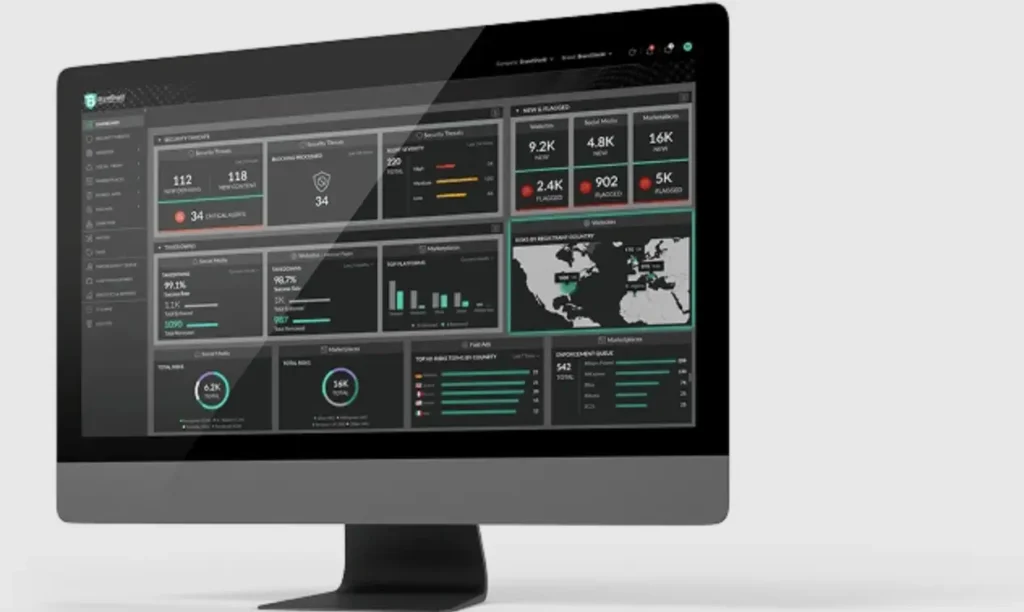
BrandShield is a brand protection platform founded in 2014 and headquartered in Israel, serving brands in finance, retail, e-commerce, and pharmaceuticals, with clients including eToro, Arc’teryx, Dropbox, Tiffany & Co., and Levi’s.
BrandShield’s strongest differentiator is its AI.ClusterX technology, which maps networks of threat actors operating across multiple channels simultaneously. This lets enforcement teams trace related counterfeit product sellers, brand impersonation accounts, and phishing domain networks back to common source actors.
On G2, BrandShield holds a 4.7/5 rating from 118 reviews, the highest review volume in this comparison. Customers frequently praise the platform’s proactive threat hunting team, intuitive dashboard, and strong takedown accuracy rates.
That said, BrandShield falls short in several important areas. The platform doesn’t offer unlimited takedowns: enforcement is capped by plan tier, which forces teams to prioritize rather than address all infringements. The platform misses SMS-based phishing scams, a gap confirmed by multiple G2 reviewers.
BrandShield also requires client confirmation before acting on sites with possible existing business relationships, which can delay enforcement response. Reporting is manual rather than automated, adding internal overhead.
What are BrandShield’s pros and cons?
BrandShield’s AI.ClusterX threat network mapping and 118 G2 reviews give it the most validated social proof in this comparison, but plan-tiered enforcement caps and a confirmed SMS phishing blind spot limit its scope for brands facing high-volume counterfeit product infringement.
Pros
- 118 G2 reviews with a 4.7/5 rating, the most validated social proof in this comparison
- AI.ClusterX maps threat actor networks across multiple channels simultaneously
- Proactive Security Operations Center and a dedicated threat hunting team per client
- Covers dark web monitoring, fake apps, paid ads, and counterfeit product listings
- Dashboard works on mobile devices for on-the-go monitoring
- Generally positioned as more affordable than enterprise-focused alternatives
Cons
- No unlimited takedowns: enforcement capped by plan tier
- SMS phishing scams are a confirmed detection blind spot
- Requires the client sign off before acting on sites with possible existing relationships
- No automated reporting: manual report generation required
- No confirmed domestic Chinese marketplace coverage
- No entry-level pricing tier for small businesses despite strong SMB appeal
What brand protection tools does BrandShield offer?
BrandShield’s tools cover counterfeit product listings, phishing domain networks, dark web threat monitoring, and actor network mapping through AI.ClusterX, with enforcement volume capped by plan tier rather than operating on an unlimited basis.
- AI-powered detection: Detects counterfeit product listings, phishing domains, lookalike websites, gray market sellers, and fraudulent paid ads
- Marketplace and social monitoring: Tracks counterfeits and impersonation on Amazon, eBay, Instagram, Facebook, and other platforms
- BrandShield Resolve: External cybersecurity monitoring and takedowns through AI for external cyber threats
- Intelligence dashboards: Visualize incidents, takedown progress, and enforcement ROI
- Enforcement support: Dedicated enforcement manager handles complex takedowns and escalation
- Wider brand threat monitoring: Covers the dark web, rogue mobile apps, paid ads, and actor network mapping with AI.ClusterX
How much does BrandShield cost?
BrandShield pricing varies by plan and service mix. The platform is positioned as more affordable than the industry average for comparable protection. For more details, read our full Red Points vs BrandShield comparison.
5. Bolster
Best for: IT teams facing domain phishing issues.
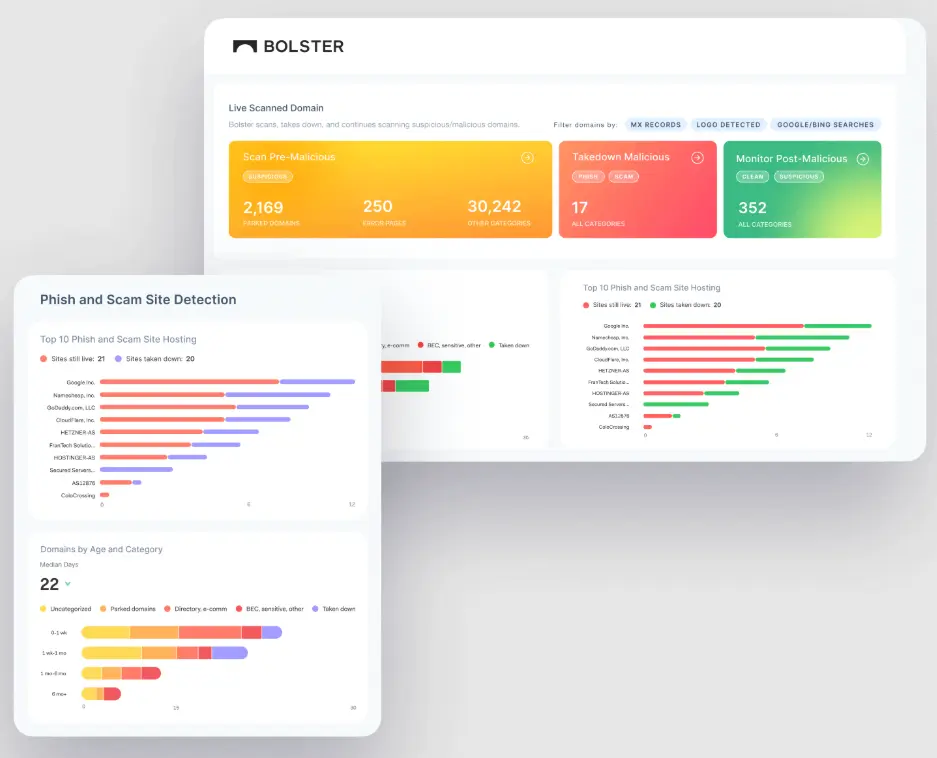
Bolster is an AI-powered security platform founded in 2017 and headquartered in Los Altos, California. The platform focuses on phishing website detection, brand impersonation on websites and social media, lookalike domain monitoring, and dark web threat intelligence.
Bolster primarily targets financial services teams and enterprise security operations, positioning itself more as a cybersecurity tool than a dedicated brand protection platform. Its strongest capability is detection speed: Bolster states an average takedown time of approximately 12 hours for phishing and impersonation incidents, backed by direct API relationships with domain registrars like GoDaddy, Cloudflare, and Namecheap.
Where Bolster falls short is in breadth. The platform does not cover counterfeit product listings on e-commerce marketplaces, which excludes it from consideration for brands with counterfeiting problems on Amazon, Tmall, or other major retail platforms. Social media enforcement requires manual submission rather than automation and is billed as an add-on.
On G2, Bolster holds a 4.6/5 rating from just 7 reviews, concentrated almost entirely in financial services. Despite its speed-focused positioning, at least one enterprise reviewer reported takedowns taking months. Unlimited takedowns are available only on the most expensive plan, at approximately $50,000 per year. Bolster is English only, with no multilingual support.
What are Bolster’s pros and cons?
Bolster’s 12-hour phishing takedown SLA and direct API relationships with domain registrars like GoDaddy and Namecheap make it a strong fit for financial services security teams, but the absence of counterfeit product marketplace enforcement excludes it from consideration for consumer goods brands.
Pros
- Fast phishing and impersonation takedown SLA of approximately 12 hours
- Direct API partnerships with GoDaddy, Cloudflare, and Namecheap for fast domain-layer enforcement
- AI-powered phishing email detection and crowd-sourced customer threat intelligence
- Dark web credential and phishing kit exposure monitoring
- Automatic removals for phishing and impersonation incidents on supported channels
- 32 verified integrations, including Microsoft Sentinel, Snowflake, Splunk, and Okta
Cons
- No counterfeit product enforcement on e-commerce marketplaces
- Social media takedowns are manual and billed as an add-on, not included in base plans
- Unlimited takedowns only on the most expensive plan at approximately $50,000 per year
- Some enterprise reviewers reported takedown completion times of months, not hours
- Only 7 G2 reviews, concentrated almost entirely in financial services
- English only, with no multilingual support
- Feature rollouts delayed after public announcements
What brand protection tools does Bolster offer?
Bolster’s tools are built around phishing website detection, lookalike domain monitoring, and dark web credential exposure, with no enforcement capability for counterfeit product listings on e-commerce marketplaces like Amazon, Tmall, or eBay.
- AI phishing detection: Identifies phishing pages, spoof sites, and lookalike domains using advanced AI models
- Monitoring and takedowns: Covers domain registrations, social media channels, and app stores for phishing and impersonation removal
- Email security: Detects phishing in email campaigns and aggregates customer-reported threat intelligence signals
- Risk scoring: Assigns risk scores to flagged infringements for enforcement prioritization
- Bolster Signals: Global threat intelligence feed covering phishing incidents and organized cybercrime activity
How much does Bolster AI cost?
Bolster offers tiered plans by annual takedown volume. Unlimited takedowns are available only on the top-tier plan, at approximately $50,000 per year.
6. CSC
Best for: Brands prioritizing domain security, DNS protection, and phishing enforcement.
Corporation Service Company (CSC) has operated since 1899 and offers domain management, DNS security, and brand enforcement as one product line within a large professional services firm.
CSC’s DomainSec platform focuses on protecting enterprise domain portfolios from cybersquatting, DNS hijacking, DNS cache poisoning, and distributed denial-of-service attacks. The platform uses AI and clustering tools to identify fraudulent domain registrations and integrates domain security with basic brand monitoring. CSC is best suited for large enterprise organizations that need centralized domain portfolio management alongside foundational brand monitoring.
CSC’s limitations are significant for brands with counterfeiting or social media impersonation exposure. The platform covers domain protection and limited brand monitoring but does not offer counterfeit product enforcement, social media impersonation takedowns, anti-piracy, or gray market distributor removal.
On G2, the CSC DomainSec product has zero reviews, meaning there is no validated customer feedback on its real-world performance. This is a meaningful credibility gap compared to platforms with 50, 118, or even 29 verified reviews.
What are CSC’s pros and cons?
CSC’s institutional knowledge of domain law and enterprise domain portfolio management carries value for registrar-level threats, but it’s a poor fit for brands whose counterfeiting exposure extends to marketplaces, social media impersonation accounts, or app stores.
Pros
- Long operational history since 1899 with institutional knowledge of domain law and registrar relationships
- Strong domain portfolio management for enterprises with hundreds or thousands of domains
- DomainSec dashboard uses AI and clustering for daily threat alerts and weekly reports
- Integrates domain security and basic brand protection monitoring in one platform
- 3D Domain Security program provides comprehensive domain threat visibility
Cons
- Zero G2 reviews for CSC DomainSec: no validated customer social proof
- Does not cover counterfeit product listings on e-commerce marketplaces
- No social media impersonation takedown capability
- No anti-piracy services
- No gray market or unauthorized distributor enforcement
- Service breadth score of 0.25, the lowest in this comparison
- Not designed for small or mid-sized businesses
What brand protection tools does CSC offer?
CSC’s tools are concentrated in domain security and DNS threat protection, covering cybersquatting and DNS hijacking but not counterfeit product enforcement, social media impersonation takedowns, or anti-piracy removal.
- Brand enforcement services: Monitors ISPs, domain registrars, social media platforms, marketplaces, and app stores for scam content
- Domain security: Protects against cybersquatting, DNS hijacking, DNS cache poisoning, and DDoS attacks
- Domain portfolio management: Manages large enterprise domain portfolios across multiple registrars
- 3D Domain Security: Delivers daily alerts and weekly reports on domain threat exposure
- Team support: CSC analysts work alongside digital tools to oversee enforcement actions
How much does CSC cost?
CSC pricing depends on service scope, structured around digital service credit packages applied across different brand protection services.
7. OpSec
Best for: Teams that need product authentication, track-and-trace, and offline investigation support.
OpSec Security is a brand protection provider that acquired MarkMonitor’s legacy brand protection capabilities from Clarivate Analytics. OpSec itself was subsequently acquired by Crane NXT, a physical security company.
OpSec does not have a G2 profile, and neither does its parent company, Crane Authentication (now operating as Crane NXT), so no verified customer reviews are available on any major B2B software review platform.
This brand protection provider is best suited for enterprise brands that need hybrid digital and physical protection, combining online enforcement with product traceability and authentication capabilities. The company scans more than 1,000 marketplaces and 30 social media platforms daily and has experience serving governmental agencies alongside large enterprise clients.
OpSec stands out for a wide service portfolio covering ad protection, anti-counterfeiting, anti-impersonation, anti-phishing, anti-piracy, domain management, gray market monitoring, investigations, trademark management, and track-and-trace. However, our review of OpSec’s technology maturity shows it focuses on manual and human-intensive methods rather than AI-first automation.
Looking at drawbacks, OpSec’s services are generally too complex and costly for small or mid-sized brands. Onboarding is extensive, and the service model emphasizes offline and physical security capabilities that many digital-first brands don’t need.
What are OpSec’s pros and cons?
OpSec’s hybrid digital and physical brand protection gives it the broadest service portfolio in this comparison, but its legacy technology focus places it behind more AI-native alternatives.
Pros
- Broadest service portfolio in this comparison, including physical product authentication and track-and-trace
- Hybrid digital and physical brand protection with offline investigation capabilities
- Scans 1,000+ marketplaces and 30 social media platforms daily
- Experience serving governmental agencies and large multinational enterprise clients
- IT security tool integration to embed brand intelligence in existing enterprise security stacks
Cons
- No G2 profile for OpSec or parent company Crane Automation
- Greater emphasis on manual, human-intensive workflows than AI-first automation
- Service scope is too complex for small and mid-sized brands
- Onboarding is extensive and may take longer than AI-native competitors
- Pricing above the industry average
- No confirmed domestic Chinese marketplace coverage
What brand protection tools does OpSec offer?
OpSec’s tools span counterfeit product detection on 1,000+ marketplaces, physical product authentication, track-and-trace supply chain monitoring, and IT security integration, giving it the widest service scope in this comparison at the cost of AI automation depth.
- Comprehensive detection: Identifies infringements on marketplaces, app stores, domain registrations, social media platforms, and streaming services
- Automated enforcement: Platform removes infringing content automatically at scale
- IT security integration: Brand intelligence connects with existing enterprise security tool stacks
- Visual AI: Detects counterfeit products using logo matching, product image analysis, and trademarked text recognition
- Early Warning System: Delivers daily reports on fraud and infringement activity across monitored channels
- Track and trace: Physical product authentication and supply chain integrity monitoring
How much does OpSec Security cost?
Pricing is positioned above the industry average, reflecting enterprise scope, service complexity, and offline investigation capability. For more details, read our full Red Points vs OpSec comparison.
Disclaimer
This comparison is based on publicly available product documentation, vendor websites, and customer feedback shared during evaluations and reviews, as of December 2025. Capabilities, pricing models, and enforcement approaches may change over time.
What does brand protection software accomplish?
Brand protection platforms monitor intellectual property across digital channels, detect unauthorized use, and carry out takedowns of infringing content through automated enforcement. The core targets include counterfeit product listings on e-commerce marketplaces, fraudulent social media accounts, phishing websites, brand impersonation in paid ads, unauthorized domain registrations, and gray market distributor listings that violate pricing or territorial agreements.
Each protection type addresses a different revenue and risk mechanism. Counterfeit product listings on Amazon, eBay, or Tmall, for example, divert sales and damage perceived quality when buyers receive poor-quality knock-offs. According to our 2025 Counterfeit Buyer Teardown report, 46% of counterfeit purchases are unintentional, with American marketplaces and social media channels as the most common entry points.
Phishing websites and fake brand social accounts steal customer payment credentials and route transactions to fraudulent sellers. Gray market distributor listings undercut authorized dealer pricing, violate MAP agreements, and erode channel trust.
The core technical functions of brand protection platforms include:
- Monitoring: Continuous scanning across e-commerce marketplaces, social media platforms, domain registries, app stores, search engines, and the deep web
- Detection: Automated identification of infringements through keyword search, image recognition, logo matching, optical character recognition, and machine learning models
- Enforcement: Filing DMCA notices, submitting marketplace removal reports, contacting domain registrars, and processing UDRP filings
- Reporting: Dashboards showing incident trends, seller risk patterns, and revenue impact
Not all platforms cover every channel or threat type. A tool built around phishing domain detection may not enforce counterfeit sneaker listings on a Chinese e-commerce platform. A trademark management platform designed for registrar-level protection might not monitor social media impersonation accounts at all. So what should you do? Map your actual threat surface before evaluating vendor capabilities, not the other way around.
Why does the right brand protection software matter?
The wrong brand protection platform may protect against some threats but miss others for your brand, which could include things like fraudulent Instagram shopping ads, counterfeit listings on domestic Chinese marketplaces, or fake brand checkout pages. These would continue damaging your brand while the platform addresses only the threats it knows how to handle.
The scale of counterfeits is significant. According to a joint OECD and EUIPO analysis, global trade in counterfeit and pirated goods exceeds $467 billion annually. Our 2025 Counterfeit Buyer Teardown report shows where specific damage is accelerating:
- 4.3 million counterfeit product listings and impersonation accounts were detected in 2024, a 15% year-over-year increase
- Fraudulent social media ads redirecting buyers to infringing checkout pages surged 179% between 2023 and 2024
- Standalone fake brand website infringements grew 59% across Red Points’ client base between 2022 and 2024, with a further 70% increase projected by the end of 2025
Customer churn is the main damage mechanism. Nearly 1 in 3 accidental counterfeit buyers stopped purchasing from the original brand after the experience, our data shows. In luxury goods, 32% of those buyers never returned, because buyers who receive a counterfeit skincare serum or an imitation consumer electronic through a fake checkout page blame the original brand for the product failure, not the fraudulent seller operating behind it.
Platform choice determines which of these events gets intercepted before the damage occurs. A platform without domestic Chinese marketplace access can’t remove counterfeit apparel listings on Pinduoduo or Goofish. A platform without social media ad enforcement cannot stop fraudulent TikTok Shopping storefronts before fashion consumers click through.
We also found that counterfeit products are typically priced 38% below retail, a discount narrow enough to avoid suspicion and precise enough to explain why 46% of all counterfeit buyers across categories don’t realize they’ve purchased a fake until after delivery.
How do the most effective brand protection platforms enforce across channels?
Effective counterfeit listing suppression depends on three factors: the enforcement pathways available (API connections to platforms, established relationships with registrars, direct portal access), the level of automation applied, and whether the platform imposes limits on takedown volume.
The gap between platforms is sharpest in infringement removal, not necessarily monitoring. Most platforms can detect infringements. Fewer can remove them quickly and consistently across every relevant channel.
Caps on enforcement volume are a significant structural disadvantage. When infringement spikes during a product launch, a seasonal counterfeiting campaign, or a viral social media moment, a capped platform stops working right when you need it most.
Platforms that charge per takedown or tie enforcement to analyst hours face the same problem: cost scales with the problem, which removes the economic incentive to remove listings aggressively. Platforms with flat-fee pricing and unlimited takedowns allow brands to enforce consistently, regardless of infringement volume.
Domestic Chinese e-commerce platforms present a specific enforcement challenge worth understanding. Platforms like Pinduoduo, Goofish, WeChat, and Douyin operate entirely within mainland China and are not accessible from outside it. Brands without a provider that operates physically inside those platforms can’t detect or enforce infringements appearing on them.
How do you choose the right brand protection tool?
Choosing a brand protection provider comes down to knowing the type of infringements you’re dealing with, then comparing enforcement models, channel coverage, and impact.
First, where are infringements actually appearing? A consumer goods brand seeing counterfeit product listings on Amazon and Tmall needs marketplace enforcement with domestic China capability. A financial services firm seeing phishing websites and executive impersonation needs a different tool entirely.
Second, does the vendor’s enforcement model scale with the problem? Analyst-hour models and per-takedown billing create costs that rise directly with infringement volume.
Third, does the platform cover key channels without gaps? Missing a major marketplace or an entire category like domestic Chinese platforms leaves significant exposure that infringers will exploit.
Lastly, how does the vendor measure and report outcomes? Takedown counts are a starting metric, but revenue impact, repeat seller rates, and enforcement success rates show whether the platform is actually reducing brand damage.
Enforcement across international jurisdictions adds another layer of evaluation criteria:
- WIPO’s UDRP system handles domain disputes across 226 jurisdictions, making it a critical enforcement pathway for brands dealing with cybersquatting and lookalike domain registrations.
- The EUIPO coordinates with EU enforcement authorities and customs agencies to intercept counterfeit goods at European borders.
- The United States Patent and Trademark Office (USPTO) is the registering body for American trademarks and supports enforcement through Customs and Border Protection.
- Brands selling in China must navigate enforcement mechanisms specific to domestic platforms, including Taobao’s intellectual property protection portal and Pinduoduo’s rights-holder complaint system. A brand protection platform with experience filing inside those systems is better positioned to achieve fast, consistent removal outcomes than one that relies on external legal channels.
What’s next
Red Points leads this list because unlimited takedowns, domestic Chinese marketplace access, and AI trained on 2.7 billion monthly data points produce enforcement outcomes no analyst-hour model can match at scale. For brands facing counterfeit product listings, phishing storefronts, or gray market distributor abuse, platform choice determines whether those threats compound or get cut off.
Brand protection software FAQs
What is the best brand protection platform in 2026?
The best brand protection platform in 2026 depends on your threat profile, but Red Points is the strongest fit for brands facing high-volume abuse across marketplaces, social media, websites, domains, ads, apps, impersonation, gray market networks, and domestic Chinese platforms.
Red Points combines AI-powered detection, unlimited detections and takedowns, expert-managed enforcement, seller risk prioritization, and broad channel coverage across marketplaces, social media, websites, domains, ads, apps, and domestic Chinese platforms. This makes it especially effective for brands that need scalable enforcement without cost volatility as infringement volumes rise.
Other platforms may be better suited for narrower use cases. Corsearch is a strong fit for trademark lifecycle management and offline investigations. BrandShield is more focused on cybersecurity-led brand protection. Bolster is best suited for phishing and domain abuse. Netcraft is strongest for cybercrime, phishing, and online infrastructure threats.
Does Red Points protect against phishing and impersonation?
Yes. Red Points helps brands detect and remove fake websites, impersonation accounts, fraudulent paid ads, suspicious domains, and other forms of brand abuse beyond marketplace counterfeits. It also covers marketplaces, social media, websites, domains, apps, piracy, gray market sellers, and domestic Chinese platforms.
Which brand protection platform offers unlimited takedowns?
Red Points offers unlimited detections and unlimited takedowns through a flat-fee model. This means enforcement capacity is not capped by takedown volume, analyst hours, or per-incident pricing.
This matters because infringement volumes often spike during product launches, seasonal campaigns, viral moments, or peak shopping periods like Black Friday. With capped enforcement models, brands may have to choose which infringements to remove first or pay more as the problem grows.
Red Points’ unlimited model allows brands to keep enforcing consistently, even when counterfeit listings, fake websites, fraudulent ads, or impersonation accounts spike suddenly.
Which brand protection platform covers phishing, impersonation, domains, ads, and marketplaces?
Red Points covers phishing websites, impersonation accounts, domains, paid ads, marketplaces, social media, websites, apps, gray market abuse, piracy, and domestic Chinese platforms.
This broad coverage is important because brand abuse rarely stays within one channel. A counterfeit seller may use marketplace listings to sell the product, social media ads to drive traffic, fake websites to collect payments, and impersonation accounts to build trust with buyers.
Platforms that only cover one threat type, such as phishing domains or marketplace listings, can miss the broader abuse network. Red Points is designed to connect those signals across channels, prioritize the highest-risk threats, and enforce through the right pathway for each platform.
What is the cost of online brand protection software?
The cost of online brand protection software depends on channel coverage, infringement volume, enforcement model, and whether takedowns are capped or unlimited.
Per-takedown and analyst-hour models create problems because costs rise directly with infringement volume. This means a product launch, viral moment, or seasonal counterfeiting spike makes enforcement more expensive when it’s urgent. Brands on analyst-hour contracts could run out of enforcement capacity mid-quarter, leaving active counterfeit product listings and fraudulent paid ads live until the next billing cycle.
Flat-fee models with unlimited detections and takedowns remove that variable. Red Points’ flat-fee structure includes unlimited enforcement by channel, so a 10x infringement spike during Black Friday doesn’t mean a 10x invoice.
Can online brand protection be done manually?
Manual online brand protection can work for a small number of SKUs and channels, but it becomes difficult to scale once counterfeit sellers rotate accounts, domains, ads, and storefronts. Removing one counterfeit sneaker listing on Amazon often triggers 5 to 10 new listings from accounts within the same seller network, and manual search can’t reveal those connections.
Looking at it another way, an IP-ops analyst spending 20 hours per week filing individual DMCA notices and marketplace removal reports is operating 100 times slower than an automated platform scanning 2.7 billion data points per month.
The hidden cost is also personnel. Manual enforcement at scale requires a dedicated IP-ops headcount whose time is consumed by data sorting. On the other end of the spectrum, with Red Points, Cotopaxi recovered 130+ analyst hours per quarter by switching from manual tracking to automated detection.
How long does it take to see results from brand protection software?
Brands can often see initial takedown results within the first two to four weeks, while broader seller network disruption usually takes three to six months.
Seller clustering is the mechanism that determines long-term impact. A platform that treats each infringing listing in isolation removes individual counterfeit board game listings but leaves the seller infrastructure intact. On the other hand, a platform with cross-channel seller intelligence identifies that the same infringer operates 40 storefronts across Amazon, eBay, and Taobao under rotating account names, then disrupts all 40 simultaneously. CATAN, for example, saw 224,000 counterfeit board games removed using this approach with Red Points and recorded its best sales year directly after.
How does brand protection software avoid false positives?
Brand protection software avoids false positives by combining AI detection with allowlists, seller-level rules, domain rules, price thresholds, geographic filters, and expert review for edge cases.
False positives could happen in a few scenarios: authorized reseller programs where third-party Amazon marketplace sellers hold legitimate inventory, gray market distributor accounts selling genuine but geographically unauthorized products, or for premium segment sellers whose price points and imagery closely resemble the original brand.
A pure AI system trained on infringer data can have difficulty distinguishing a legitimate parallel importer from an unauthorized gray market distributor, for example, because both use genuine product images and brand trademarks.
Whitelist rules address this, but they require configuration. Effective platforms let brands whitelist by seller ID, domain, price threshold, or geographic region, beyond brand name. Red Points uses a hybrid model: automation handles detection and prioritization across the high-risk seller shortlist, while IP-ops specialists validate edge cases involving authorized reseller relationships and complex gray market distributor accounts before enforcement is filed.
Why is brand protection software necessary?
Brand protection software is necessary because counterfeit product listings and phishing checkout pages generate brand damage whether or not the brand is watching. A buyer who receives a counterfeit skincare serum from a fake Instagram storefront doesn’t report the seller. They leave a one-star review on the original brand’s legitimate Amazon listing, and nearly 1 in 3 stop buying from the brand entirely. The threat compounds when you don’t monitor and enforce takedowns.
Unprotected, brands face:
Revenue diversion: Sales lost to counterfeit product sellers, unauthorized supplement distributors, and gray market resellers undercutting MAP pricing
Reputation damage: Negative reviews attributed to the original brand after buyers receive counterfeit cosmetics, fake electronics, or poor-quality knock-off apparel
Data and safety risk: Buyers are exposed to phishing checkout pages, fraudulent brand websites, and unsafe counterfeit products, including unregulated health supplements and counterfeit children’s toys
Is Red Points only for ecommerce brand protection?
No. Red Points is often associated with ecommerce and counterfeit protection, but the platform covers a much broader brand protection scope.
Red Points protects brands across marketplaces, social media, websites, domains, paid ads, apps, AI commerce, piracy, impersonation, gray market abuse, and domestic Chinese platforms. This makes it relevant not only for ecommerce brands, but also for companies dealing with fake websites, social media impersonation, unauthorized sellers, fraudulent ads, pirated content, and cross-channel seller networks.
For brands facing abuse across multiple channels, Red Points provides a single platform and managed service model to detect, prioritize, enforce, and measure impact at scale.