







Key takeaways
- Alibaba is one of the world’s largest and most legitimate B2B platforms, but its open marketplace model means counterfeiters and brand impersonators operate alongside genuine suppliers.
- Scammers don’t just target buyers on Alibaba. They actively impersonate brands, use stolen trademarks and product imagery, and sell counterfeit versions of your products at scale.
- Alibaba has invested heavily in IP protection tools, including a dedicated IP Protection Platform that resolves the vast majority of valid infringement claims within 24 hours.
- Removing listings on Alibaba.com is only part of the picture. Many counterfeit operations are based on domestic Chinese platforms like Douyin, Pinduoduo, and WeChat, which require separate, localized enforcement.
- The fastest way to protect your brand is to combine trademark registration, Alibaba’s IP Protection Platform, and automated 24/7 scanning across global and domestic marketplaces.
Alibaba.com hosts millions of legitimate supplier listings, but there are some scam operators who impersonate real brands, sell counterfeit goods at scale, and exploit the platform’s open model to reach global buyers. This guide explains how counterfeit sellers use Alibaba to target established brands, what warning signs to monitor, and how to use Alibaba’s enforcement tools alongside automated monitoring to protect your brand across both Alibaba.com and China’s domestic digital ecosystem.
What is Alibaba?
Alibaba.com is the world’s largest B2B e-commerce platform, connecting manufacturers and wholesalers, primarily based in China, with businesses across the globe. It is part of the Alibaba Group, which also owns AliExpress, Taobao, Lazada, and Tmall. Founded in 1999 by Jack Ma, the group serves over one billion annual active customers worldwide, making it the single largest commercial infrastructure platform on the planet.
For brands, that scale creates a specific challenge. Alibaba.com is not a curated retailer; it is a directory of suppliers. The sheer volume of listings across the platform makes it practically impossible to manually monitor for counterfeits, unauthorized resellers, and brand impersonators without the right tools in place. The International Chamber of Commerce estimates the total global economic impact of counterfeiting and piracy could reach $4.2 trillion and put 5.4 million legitimate jobs at risk, and open B2B platforms are a primary distribution channel for that activity.
Is Alibaba a legitimate platform?
Yes. Alibaba.com is a publicly traded, legitimate B2B marketplace that facilitates billions of dollars in real trade annually. The platform itself is not a scam, and Alibaba has made significant, sustained investments in anti-counterfeiting infrastructure. In 2023 alone, its anti-counterfeiting alliance protected 730,000 brands and resolved 98% of reported IP infringement claims within 24 hours.
Like all large open marketplaces, however, Alibaba’s scale also attracts bad actors who attempt to exploit its reach. The challenge for brands is not the platform itself, but the minority of fraudulent sellers who operate within it, and the speed at which they can scale infringing activity across millions of active listings.
For brands, the right question is not “Is Alibaba legit?” but “Is my brand being counterfeited on Alibaba right now?” For many established brands, the answer is very likely yes, and early detection is what limits the damage.
How do scammers use Alibaba to target brands?
Understanding these tactics helps brands identify what to monitor and report. Most operate simultaneously and at scale.
1. Fake supplier profiles impersonating your brand
This is one of the most direct threats to established brands. Scammers create free, unverified Alibaba profiles using the name, logo, and contact details of a legitimate brand or its authorized manufacturers. These fake profiles often include stolen product photography, copied certification documents, and fabricated “factory” addresses. Buyers who discover the product is fake or who receive nothing at all associate the bad experience with the brand being impersonated.
2. Counterfeit listings using your trademarks and product imagery
Sellers list counterfeit versions of your products using your brand name, registered trademarks, and official product images scraped from your website. These listings appear in search results alongside legitimate wholesale inquiries, and buyers, particularly those unfamiliar with your authorized distribution channels, may place large bulk orders without realizing the products are fake.
3. Unauthorized resellers claiming factory-direct pricing
Some sellers present themselves as “original manufacturers” or “authorized export partners” of your brand, claiming they can offer your products at lower prices by “cutting out the middleman.” These claims are false as most established brands do not sell direct-to-buyer on Alibaba. These listings mislead buyers while simultaneously diluting the brand’s pricing integrity in the market.
4. IP and design theft
Brands that source custom-manufactured products through Alibaba face a specific risk: the supplier produces the agreed design, then sells it independently to other buyers or competitors. The brand funded the product development, created a market for the item, and now faces direct competition from the factory that manufactured it. This is particularly common in apparel, electronics, accessories, and consumer goods.
5. AI-enhanced fake brand storefronts
An increasingly serious threat as of 2026 is the use of AI-generated content to create highly convincing counterfeit brand presences on Alibaba. Fraudulent sellers can now use AI tools to generate professional product descriptions, realistic factory photos, and plausible company histories that easily pass a casual review. AI-generated communications sent to buyers, impersonating your brand’s sales team, have also increased significantly. According to KnowBe4’s 2025 Phishing Threat Trends Report, 82.6% of phishing emails now exhibit some use of AI, making “bad English” an increasingly unreliable indicator of fraud.
6. High-quality sample, low-quality bulk
A manufacturer sends a genuine, high-quality product sample, sometimes even using your authentic branded goods, to win a bulk order. When the shipment arrives, the products are clearly inferior: cheaper materials, poor finishing, incorrect specifications, and fake versions of your trademarks. This scam damages brands when the counterfeit bulk order enters the supply chain and reaches end consumers.
7. Price increase after order placement
Suppliers quote an attractive price to initiate negotiations, take a deposit, then raise the price, citing rising raw material costs. Brands with authorized suppliers on Alibaba can be collateral damaged when buyers, frustrated by these experiences, blame the brand whose name was invoked throughout the process.
8. Non-delivery and disappearing suppliers
Fraudulent suppliers complete transactions and then vanish, sometimes at the end of their annual membership period. These operators often create phishing websites that mimic legitimate manufacturers, directing buyers to pay into personal accounts. The buyer’s loss and the associated brand damage are real, even though the brand had no involvement.
What are the warning signs that your brand is being targeted on Alibaba?
Brands should monitor for these specific signals:
- Listings using your brand name, logo, or registered trademarks without authorization.
- Supplier profiles claiming to be your “official factory,” “authorized distributor,” or “export partner.”
- Product images that appear to be scraped from your official website or marketing materials.
- Pricing significantly below your wholesale rates, used to attract buyers away from authorized channels.
- Customer complaints about products they “bought from Alibaba” that do not match your quality standards.
- Sellers using your proprietary product designs or custom specifications in their listings.
What should you do if your brand is being targeted on Alibaba?
Acting quickly limits both the commercial damage and the reputational harm. Here is the step-by-step process.
Step 1: Register your trademarks and copyright
Before you can file a successful takedown on any platform, your intellectual property must be formally registered. Register your trademarks in relevant jurisdictions, including China, where Alibaba’s suppliers are primarily based. Copyright your product imagery, packaging, and website content. Without a registered IP, your takedown options are significantly limited.
Step 2: Enroll in Alibaba’s IP Protection Platform
Alibaba Group operates a dedicated IP Protection Platform that allows brand owners to report and request removal of infringing listings. Once enrolled, you can submit takedown requests directly, and Alibaba commits to resolving valid IP infringement claims within 24 hours in the vast majority of cases. Enrollment requires proof of trademark registration and company verification.
Step 3: Document the infringing listings
Before filing a takedown, capture comprehensive evidence: screenshots of the listing with the URL and date visible, records of the seller’s profile, any communications, and examples of how your trademarks or product imagery are being misused. This documentation supports your claim and creates a paper trail for any follow-up action.
Step 4: File takedown requests and monitor for re-listings
Submit takedown requests through Alibaba’s IP Protection Platform. Counterfeiters frequently re-list under new accounts after removal, often within days. This is why one-time takedown efforts are rarely sufficient, continuous monitoring is what keeps re-listers from recovering their footing.
How does Red Points handle marketplace takedowns?
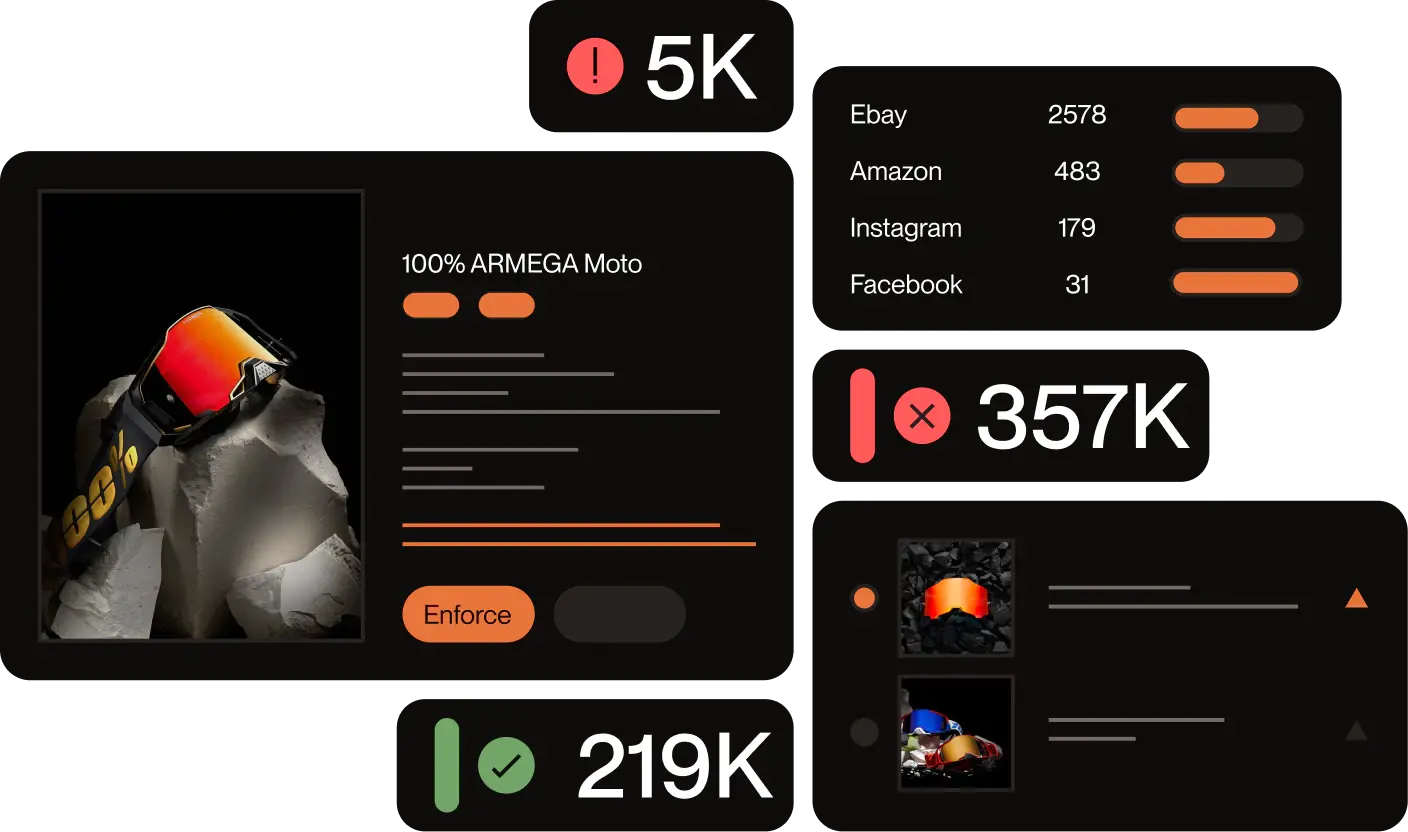
Manual monitoring of Alibaba’s millions of listings is not operationally viable at the pace of counterfeiting moves. Red Points’marketplace protection follows a three-stage workflow designed to find, remove, and measure infringements at scale, with no caps on detection or enforcement volume.
Find. Bots crawl 5,000+ global marketplaces every day, using AI trained on 2.7 billion data points monthly. The system detects altered spellings, image-based brand misuse, and hidden logos, not just exact-match keyword searches. This means infringers who deliberately obfuscate their listings are still caught.
Remove. Once a potential infringement is validated, Red Points automatically initiates the takedown process using each platform’s specific enforcement workflows. There are no analyst-hour limits or peak-time surcharges; enforcement runs 24/7 with no small print. For cases that require escalation beyond automated takedown, Red Points’ Revenue Recovery Program can pursue zero-cost litigation to recover funds directly from counterfeiters and close down seller accounts permanently.
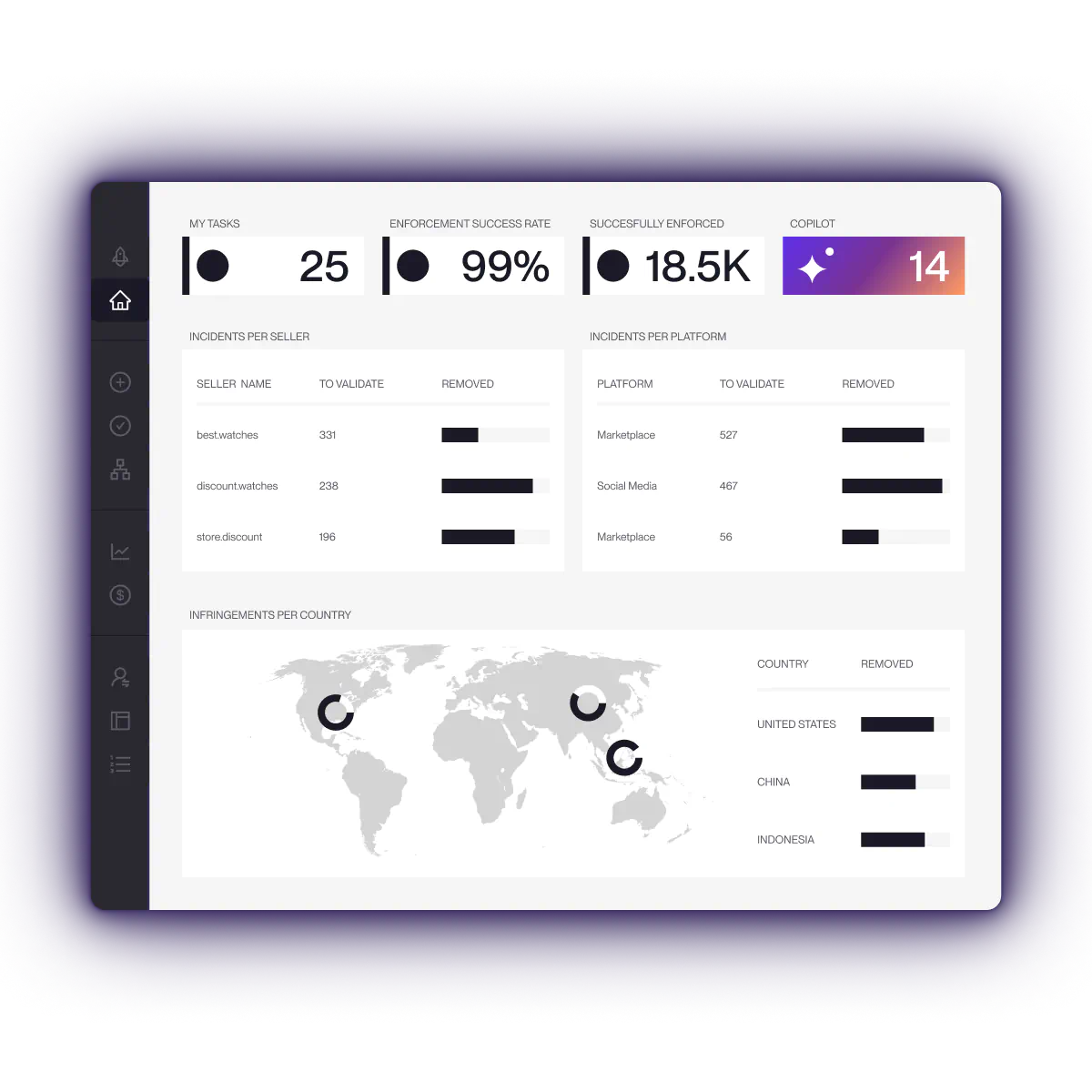
Measure. Brands get performance dashboards showing detections, removals, and seller-level activity across platforms, with real-time data that connects enforcement actions to commercial outcomes.

Does monitoring Alibaba cover your brand in China?
Not entirely, and this is a gap most brands don’t account for.
Alibaba.com connects international buyers with Chinese suppliers, but the counterfeit supply chain behind those listings is largely based in China’s domestic digital ecosystem: platforms like Douyin, Pinduoduo, WeChat, and Xianyu that operate entirely independently from Alibaba and from global marketplaces. A brand can successfully remove every infringing listing on Alibaba.com and still have dozens of active counterfeit sellers operating across Chinese domestic platforms, completely invisible to standard monitoring.
For brands selling in or sourcing from China, and for those whose products are frequently counterfeited by Chinese manufacturers, Red Points’ Mainland China Protection provides a dedicated layer of enforcement inside China’s closed digital ecosystem. This includes:
- Chinese-language AI and image recognition to detect altered spellings, hidden logos, and image-based brand misuse on domestic platforms
- Native-speaker review to capture evasive sellers that automated detection alone might miss
- Localized enforcement workflows aligned with each platform’s specific IP and documentation requirements
- Managed follow-up and escalation to reduce re-listing and limit repeat abuse
Brands that don’t sell in China are not exempt from this risk. Domestic Chinese platforms are frequently used to manufacture and distribute counterfeit goods globally, including cross-border shipments to markets where the brand does have a presence. The absence of an official China market presence does not prevent counterfeit activity; it can actually make it easier for counterfeiters to operate, since there is no local authorized channel for buyers to compare against.
How does Alibaba’s IP Protection compare to automated brand protection?
| Feature | Alibaba IP Protection Platform | Manual Monitoring | Red Points Automated Detection |
|---|---|---|---|
| Coverage | Alibaba.com only | Limited by human capacity | Alibaba + 5,000+ marketplaces |
| Speed of detection | After you find and report | Slow — misses most listings | 24/7 continuous scanning |
| Takedown speed | 98% within 24 hours | Depends on manual filing | Automated — same-day submission |
| Re-listing monitoring | Not included | Requires repeated searches | Continuous — catches re-lists |
| China domestic platforms | Not included | Not feasible manually | Covered via dedicated solution |
| Scale | Unlimited submissions | Very limited | 30M listings processed per day |
| Cost | Free to enroll | Internal staff time | Platform subscription |
What’s next
Counterfeiting on open marketplaces is a volume problem. Too many listings, refreshing too quickly, for any brand team to monitor manually. Alibaba’s own IP tools are strong, but they require brands to surface infringements before protection can begin. And for brands with exposure in China, the domestic platforms where the counterfeit supply chain originates require a separate layer of enforcement entirely.
Red Points automates detection and takedown across Alibaba.com, 5,000+ global marketplaces, and domestic Chinese platforms, giving your brand protection that operates at the same scale as the problem itself. Request a demo to see it in action.
Frequently asked questions
Yes. Alibaba.com is a publicly traded, legitimate B2B marketplace that has operated since 1999 and facilitates billions of dollars in real trade annually. Like all large open platforms, it also faces challenges with bad actors — which is why Alibaba has built dedicated IP protection tools and invested heavily in anti-counterfeiting programs.
Yes, through its IP Protection Platform. Alibaba resolves the vast majority of valid IP infringement claims within 24 hours. However, removal is reactive — sellers frequently re-list under new accounts, making continuous monitoring essential.
Yes. Scammers can create unverified supplier profiles using your brand name, logo, and product imagery without your knowledge. These profiles operate until a brand owner or Alibaba’s systems detect and report them, which is why proactive monitoring matters.
Yes. Alibaba’s IP Protection Platform requires proof of trademark registration to accept takedown requests. This makes trademark registration in key markets — including China — a practical prerequisite for brand protection on the platform.
Alibaba’s IP Protection Platform is a free service for brand owners to submit and track IP infringement takedown requests. To enroll, visit Alibaba’s IP Protection Platform and submit your trademark registration documents for verification. Once approved, you can file takedown requests directly through the platform.
Look for listings that use your brand name, registered trademark, or official product images without authorization — particularly those claiming to be your “authorized factory” or “direct manufacturer.” Pricing significantly below your standard wholesale rates and product descriptions copied from your official website are also strong indicators.
Alibaba reviews the claim and, if valid, removes the listing typically within 24 hours. The seller may appeal or re-list under a new account. Brands should monitor for re-listings and be prepared to file follow-up takedowns or use automated tools to handle this continuously.
No. Alibaba.com and China’s domestic platforms — Douyin, Pinduoduo, WeChat, Xianyu — are completely separate ecosystems. Takedowns on one have no effect on the other. Brands that need protection inside China’s closed digital ecosystem require a dedicated solution with localized enforcement capabilities.
Alibaba.com is a B2B platform designed for wholesale orders; buyers are businesses placing large-quantity orders directly with manufacturers. AliExpress is a B2C platform where individual consumers can purchase smaller quantities. Brands may face counterfeit exposure on both platforms and should monitor each separately.